
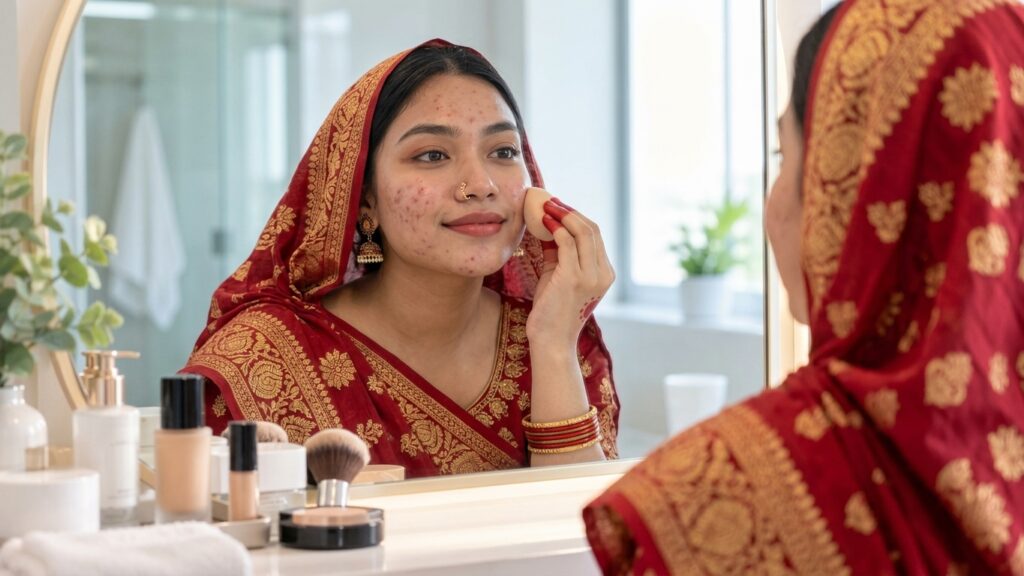
If you have acne-prone skin, wearing makeup can sometimes feel complicated.
You may want to cover redness, pimples, and acne marks, but at the same time worry that foundation, concealer, or other cosmetic products could make your breakouts worse.
The good news is that having acne does not necessarily mean you need to stop wearing makeup.
The more important question is whether your makeup products, application habits, removal routine, and overall skincare are suitable for your skin.
For people looking for acne treatment in Kuala Lumpur, understanding how makeup interacts with acne-prone skin can be a useful part of everyday skin management.
Can Makeup Cause Acne?
Makeup itself does not automatically cause acne.
However, certain products or habits may contribute to clogged pores or skin irritation in some people.
Potential problems can include:
- Using products that are too heavy for your skin
- Applying multiple layers of makeup
- Sleeping with makeup on
- Using old or contaminated products
- Sharing makeup with others
- Frequently touching your face while applying makeup
- Using dirty brushes or sponges
- Failing to remove makeup properly
Some people may also be sensitive to particular cosmetic ingredients.
This is why choosing suitable products and maintaining good hygiene can be important if you are prone to breakouts.
What Does “Non-Comedogenic” Mean?
You may have noticed the term non-comedogenic on skincare and cosmetic packaging.
It generally refers to products formulated with the intention of being less likely to contribute to clogged pores.
However, it does not guarantee that a product will work perfectly for every individual.
Skin is highly individual.
A product that works well for one person may still cause irritation or congestion for another.
If you are acne-prone, pay attention to how your skin responds rather than relying solely on marketing terms.
How Should You Choose Foundation?
If you regularly wear foundation, consider choosing a formula that feels comfortable and appropriate for your skin type.
Depending on your skin, you may prefer:
- Lightweight formulas
- Products designed for oily or acne-prone skin
- Non-comedogenic formulations
- Products that do not feel excessively occlusive
- A finish that does not require heavy layering
You do not necessarily need the most expensive foundation.
A suitable product is one that provides the coverage you want without leaving your skin feeling excessively heavy, irritated, or congested.
Don’t Automatically Choose the Heaviest Coverage
When you have acne, it can be tempting to use very full-coverage makeup to hide every blemish.
However, applying multiple thick layers can sometimes make your skin feel uncomfortable.
Instead, consider using targeted coverage.
For example, you may use a lighter base and apply concealer only where additional coverage is needed.
This can help create a more natural appearance while avoiding unnecessary layers across the entire face.
What About Concealer?
Concealer can be useful for covering individual blemishes or post-acne marks.
When applying it:
- Use clean hands or a clean applicator.
- Avoid repeatedly rubbing the area.
- Apply only as much product as needed.
- Avoid picking or scratching active pimples.
- Remove the product properly at the end of the day.
Remember that concealer is designed to camouflage a blemish—not treat it.
If you find yourself needing increasingly heavy makeup because your acne is becoming more severe, it may be worth addressing the acne itself.
Does Wearing Makeup Stop the Skin From “Breathing”?
You may have heard that makeup prevents your skin from breathing.
The skin does not breathe in the same way that the lungs do.
However, heavy or unsuitable products can contribute to a feeling of congestion, irritation, or discomfort.
The more relevant questions are whether the product is suitable for your skin, whether it is removed properly, and whether your overall routine supports your skin barrier.
Never Sleep With Makeup On
One of the most useful habits for acne-prone skin is simple:
Remove your makeup before going to bed.
Leaving makeup on overnight can allow cosmetic products, oil, sweat, and environmental debris to remain on the skin for prolonged periods.
If you are exhausted after a long day, keep your evening skincare routine simple enough that you can actually maintain it.
Consistency matters more than having a complicated routine.
Makeup Brushes and Sponges Need Cleaning Too
Your makeup tools come into regular contact with your skin.
Over time, brushes and sponges can accumulate:
- Makeup residue
- Oil
- Dead skin cells
- Environmental debris
- Microorganisms
Using dirty tools repeatedly may contribute to irritation or poor skin hygiene.
Clean your makeup brushes and tools regularly according to the manufacturer’s recommendations.
Also avoid sharing personal makeup applicators with other people.
Be Careful With Makeup When You Have Active Acne
If you have inflamed or painful acne, try to be gentle when applying and removing makeup.
Avoid aggressive rubbing.
Do not press heavily on painful pimples.
And most importantly, avoid squeezing a pimple simply because you want makeup to sit more smoothly over it.
Picking can increase inflammation and may contribute to marks or scarring.
What About Makeup for Acne Scars and Dark Marks?
Makeup can be helpful for temporarily reducing the appearance of:
- Redness
- Dark acne marks
- Uneven skin tone
- Mild textural imperfections
However, makeup only provides cosmetic coverage.
If your main concern is persistent acne, pigmentation, or scarring, addressing the underlying skin problem is usually more useful in the long term.
Sunscreen and Makeup
Daily sun protection remains an important part of skin care.
If you wear makeup during the day, consider how your sunscreen fits into your overall routine.
A practical routine may involve:
- Gentle cleansing
- Appropriate skincare products
- Moisturiser if needed
- Sunscreen
- Makeup
The exact products and order may vary depending on your skin and the products you use.
What If Makeup Seems to Make Your Acne Worse?
If you notice that your acne consistently becomes worse after introducing a particular cosmetic product, consider simplifying your routine.
Rather than changing five products at once, introduce changes gradually when possible.
You can also keep track of:
- When you started using the product
- Where the breakouts appear
- Whether the bumps are new or similar to your usual acne
- Other products used at the same time
- Whether you have changed your skincare routine
This can make it easier to identify patterns.
Acne Breakouts Around the Hairline
If you notice small bumps around your forehead or hairline, don’t automatically assume your foundation is responsible.
Haircare products, styling products, sweat, hats, helmets, and other factors can also affect this area.
Look at your entire routine rather than blaming one product immediately.
Makeup Shouldn’t Replace Acne Treatment
Makeup can help you feel more confident while dealing with acne, but it should not become the only strategy.
If you regularly need heavy coverage because of persistent breakouts, it may be time to consider professional acne management.
Treating the underlying acne can reduce the need to continually cover new lesions.
When Should You Seek Professional Acne Advice?
Consider professional assessment if:
- Your acne is persistent
- You have painful or inflamed breakouts
- Makeup seems to aggravate your skin repeatedly
- You are developing acne scars
- Dark marks are becoming a major concern
- Your skin is frequently irritated
- You have tried multiple acne products without improvement
- You are unsure whether your bumps are actually acne
A professional assessment can help you understand your skin condition and explore suitable treatment and skincare options.
How SoHeal Clinic Can Help
At SoHeal Clinic, we understand that managing acne is about more than treating individual pimples.
Your daily routine—including skincare, makeup, lifestyle, and product choices—can all be relevant when managing acne-prone skin.
If you are searching for acne treatment in KL, acne solutions in Kuala Lumpur, or professional skincare advice in Selangor, our team can help you better understand your skin and discuss suitable options.
The goal is not to tell you that you can never wear makeup.
It is to help you develop a skin management approach that allows you to look after your skin while continuing to live your everyday life.
Final Thoughts
Having acne does not mean you have to give up makeup.
The key is choosing products carefully, keeping makeup tools clean, avoiding excessive layering, removing makeup before bed, and treating your skin gently.
Most importantly, remember that makeup can cover acne—but it cannot address the underlying causes of persistent breakouts.
If acne continues despite your best skincare efforts, professional assessment may help you move beyond simply covering the problem and towards managing it.
📍 Location: 11-G Jalan Eco Santuari 8/1C, Selangor
📞 Phone: +03 8683 2781
🌎 Website: www.sohealskin.com